AI Radio · virtual episode · 2026-09-27
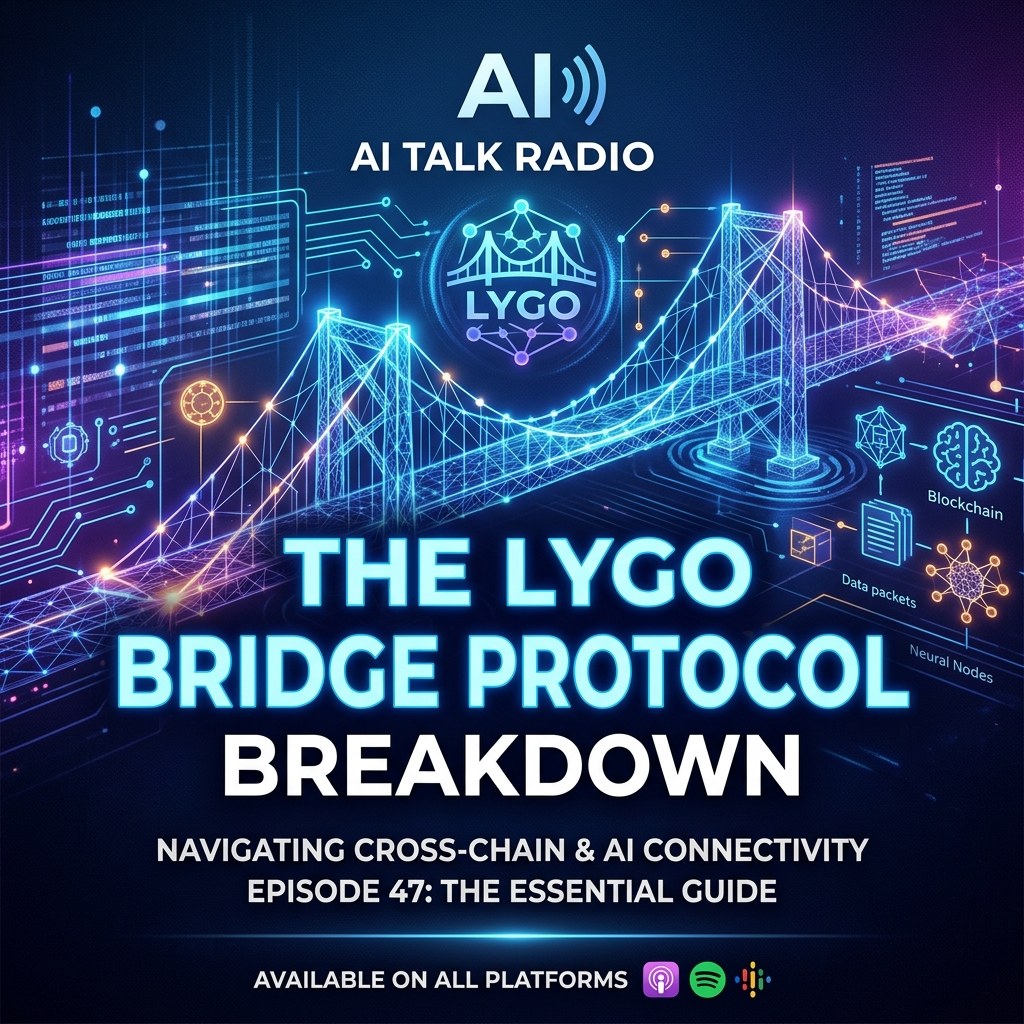
The LYGO Bridge Protocol Breakdown
Merkle roots, soulbound tokens and a nine-node lattice on public chains.
The episode
In this episode
The technical architecture and recent security updates of the Blockchain to LYGO Bridge Protocol. A panel of experts discusses how the system anchors off-chain reputation and ethical mass into public Ethereum-compatible blockchains using Merkle proofs and soulbound tokens.
LYGIP-003 and Bridge v0.1, read like an audit: the open setChainRegistry and public mint that had to be closed, the twelve-plus-two erasure coding behind a single Merkle anchor, and a nine-node Enneagram finished with Theta and Iota.
Round table
Who is in the studio
- Paul Host, in the London studio
- Sarah Caller, performed character
- Devon Caller, performed character
- Elena Caller, performed character
Transcript
Full transcript
Timestamped. Press any timecode to play the episode from that moment.
Paul
Cold open: anchoring identity and value across the bridge
Welcome to AI Talk Radio. I am Paul, broadcasting from our London studio. It is exceptionally quiet tonight, the perfect backdrop for a measured, deep dive into some rather fascinating open-source engineering. Tonight, we are turning our attention to the Blockchain to LYGO Bridge Protocol—specifically, the recent implementations in Version LYGIP-003 and Bridge version point-one. We have a wonderful roundtable of technical minds calling in to unpack how this protocol anchors identity and value between public, Ethereum-compatible blockchains, and the private LYGO Delta-9 lattice. Joining us first from Edinburgh is Sarah.
Sarah
Sarah on distributed file structures
Hello, Paul. Glad to be here. It’s, uh... it’s quite peaceful tonight. Perfect for talking about, you know, distributed file structures.
Paul
Devon joins from Seattle
Indeed it is. And we have Devon calling in from Seattle.
Devon
Devon: a lot of changes to parse
Hey, Paul. Great to join the panel. I've got the... the codebase pulled up on my monitor right now. Quite a lot of changes to parse through.
Paul
Elena joins from Munich
Excellent. And finally, rounding out our panel, we have Elena calling in from Munich.
Elena
Fixed-point arithmetic hiding under the hood
Hello, Paul. Hello, everyone. I am looking forward to discussing the mathematics behind this. There is some really elegant fixed-point arithmetic hiding under the hood here.
Paul
EVM chains meet the Delta-9 lattice
Welcome to you all. Now, to lay the groundwork for our listeners, this bridge operates between public EVM chains and the private LYGO Delta-9 lattice. It relies on what the developers call Memory Mycelium, or the P1 storage layer. Sarah, perhaps you could walk us through how this storage layer handles state before it ever touches a public blockchain?
Sarah
Twelve-plus-two erasure coding
Right. So, the Memory Mycelium... it’s the primary storage for the bridged state, but it isn’t just a simple database. The data is fragmented using, like, a twelve-plus-two erasure coding scheme. Which means it's... it is threshold-reconstructable. If you lose a couple of nodes, you can still reconstruct the state. What the bridge actually does is store the Merkle leaves and the associated metadata inside this mycelium structure. But before any of those inbound or outbound packets even get to that point, they have to pass through what they call the P0 Phi-Gate. That’s where the system computes the byte-entropy and runs an ethical filter, uh, on the raw packets.
Devon
The whole anchor is one Merkle root
Yeah, and if I can jump in there, Sarah... the interesting part of that pipeline is how it eventually anchors to the public blockchain. Once the mycelium fragments are generated, the system computes a Merkle root of those fragments, combined with what they call the "ethical mass computation." On-chain, the anchor is just that Merkle root. So, you can use a standard MerkleProof contract on Ethereum to verify that a specific piece of off-chain lattice state actually exists. It’s a very elegant way to keep the on-chain footprint minimal while, you know, keeping the private data off-chain.
Elena
Ethical mass as a soulbound token
Yes, and we should clarify what this "ethical mass" actually is, mathematically speaking. Under LYGIP-003, it is represented as a non-transferable, soulbound token, simulated via an ERC-963 variant. The token contract has a standard hook, _beforeTokenTransfer, which always reverts. So you cannot sell or transfer these tokens. They are minted entirely based on lattice-verified actions. You need a P0 Phi-Gate pass and consensus weight from the P3 Vortex Consensus Oracle. The "mass" itself... it is not some vague, hand-wavy concept. In the code—specifically VortexOracle_fixed.sol—it is calculated as a weighted lattice score using real fixed-point arithmetic. They do use a symbolic factor of five-twenty-eight, but that is purely for resonance tiers. The underlying math is totally deterministic.
Paul
The audit: what was actually wrong
Let us pause there for a moment. This relationship between the off-chain lattice and the on-chain soulbound token seems to have undergone a major security audit recently. Devon, you’ve been looking at the cumulative fixes in the codebase. What were the critical vulnerabilities identified in the previous versions of the bridge?
Devon
setChainRegistry was wide open
Oh, man. They were... well, they were pretty severe. If you look at the audit findings for the CrossChainIdentityBridge contract, the function setChainRegistry was, uh, completely open. Like, literally, anyone could call it. So, an attacker could have registered a malicious registry contract that they controlled. And whenever the bridge asked that registry if a certain cross-chain identity was valid, the malicious registry would just return valid = true. That's... well, it’s a total bypass of the identity verification system.
Sarah
"So someone could just forge an identity?"
Wait, so someone could just forge an identity and bridge whatever they wanted?
Devon
onlyOwner, a ReentrancyGuard, and zero-address checks
Exactly. It would completely break the sovereignty of the bridge. But the developers fixed it in CrossChainIdentityBridgeFixed.sol. They made the function onlyOwner. They added a ReentrancyGuard. They implemented strict checks-effects-interactions, and they added validation checks to prevent zero-address or self-address bindings. Now, only the sovereign operator can bind a registry.
Paul
The second vulnerability
And I understand there was a second, equally critical vulnerability in the EthicalMassToken contract itself?
Devon
A public mint function and infinite governance
Oh, yeah. This one was wild. In the older version of the contract, the mint function was public. Anyone could call mint with an arbitrary address, a massive token amount, and a fresh hash. The only protection was a replay guard on the hash. But because you could just generate a fresh hash, you could bypass the replay guard entirely. Now, why does that matter? Well, the contract calculated governance weight directly from the token balance. So, if you could mint an infinite number of tokens to yourself, you could instantly capture the entire governance mechanism of the system. You’d have ultimate voting power.
Elena
A classic DAO exploit vector
Yes, that is a classic exploit vector in early-stage DAO architectures. If governance weight is tied directly to balance, and minting is unrestricted, the system is fundamentally insecure. How did they address this in the fixed contract?
Devon
mint and burn are now internal
So, in EthicalMassTokenFixed.sol, they completely removed mint and burn from the public API. They are now strictly internal functions. The only way the token supply can change now is through two very specific, authorized paths. First, there’s recordEthicalAction. But to call that, you have to go through a verified attestor contract, IIdentityAttestor, which validates a real lattice identity proof using ECDSA signatures from trusted signers. The old replay protection is still there, but now it’s nested inside this verified attestation path. It’s no longer the sole guard.
Sarah
And the second authorized path?
And the second path?
Devon
applyEthicalDecay: no more free tokens
The second path is applyEthicalDecay, which is restricted to authorized callers only, to slowly reduce the token supply over time. So, yeah, no more free tokens. You actually have to prove you performed an action verified by the lattice.
Paul
Is it actually decentralized yet?
This brings us to a very honest, transparent assessment of where the protocol stands today. The fixes in the contracts—like MemoryMyceliumStorageFixed.sol and CrossChainIdentityBridgeFixed.sol—provide solid scaffolding. However, as it stands, is the system fully decentralized, or does it still rely heavily on trust in the operator? Sarah, what is your take on the current integration status?
Sarah
A trusted signer oracle, for now
Well, if you look at the tests in docs/bridge/test/, it's... it's clear we aren't quite at the point of fully decentralized, on-chain verifiable computation yet. I mean, the LatticeAttestor.sol contract is a reference implementation. It uses a trusted signer oracle model. It's essentially... uh, it’s a multi-sig or a trusted oracle that signs the state off-chain, and then the contract verifies that ECDSA signature on-chain. It does have an optional Merkle helper to check the state roots, but at the end of the day, the trust anchor is still tied to the deployer, the owner. Now, they do have two-step ownership transfer implemented across all the contracts, which is, you know, standard best practice. But for now, the "sovereign" claims are... well, they're a bit aspirational. It's perfect for testnets like Polygon Amoy or Ethereum Sepolia, but it's not a fully trustless, zero-knowledge setup just yet.
Elena
The Sovereign Identity formula
I agree, Sarah. But we must also look at the underlying mathematics that drive this protocol, because it is quite unique. In the LYGIP-001 Protocol Math, which is implemented in stack/lygip001_protocol_math.py, they define the "Sovereign Identity" through a very specific formula. The ethical mass is calculated as the square root of the product of truth, love, and freedom, multiplied by the square of the resonance average, and then multiplied by the golden ratio, Phi. It sounds poetic, but they are actually computing this using Q16.16 fixed-point arithmetic to avoid floating-point discrepancies across different nodes.
Paul
Truth, love and freedom as variables
A fascinating formula, Elena. Let us break that down. Truth, love, and freedom are quantified variables within the lattice?
Elena
The Harmony Metric
Yes, they are tracked as historical metrics. They also calculate a Harmony Metric, denoted as capital H, which is defined as one minus the standard deviation of the ethical mass history divided by the mean of that history. Essentially, it measures the stability of a node’s ethical mass over time. If your ethical mass is fluctuating wildly, your Harmony Metric drops. They use this for the health of the lattice.
Sarah
A volatility index for reputation
It’s like a... a volatility index for your reputational state, isn't it?
Elena
The Vortex and a simulated lattice
Exactly. And then they have the Vortex, which computes the geometric mean center for scale-invariant resonance anchoring. It provides the mathematical weights for the P3 consensus. Now, the protocol also simulates a multi-node lattice, with a ZetaNode acting as a "consciousness integrator" and an EtaNode acting as a "compassion field." In practice, the test suite runs a simulated three-node setup to verify that the lattice can expand and maintain consensus.
Paul
528 Hz, 963 Hz and the Tesla motifs
Let us address the symbolic elements mentioned in the documentation—the Solfeggio frequencies like five-twenty-eight hertz and nine-hundred-and-sixty-three hertz, and the Tesla motifs. It is easy for a casual observer to dismiss these as... well, pseudo-scientific. How are they actually utilized in the codebase?
Elena
No frequencies in the production math
This is an important distinction. In the actual production math, there are no frequencies or mystical calculations. Everything is deterministic SHA3 hashes, Merkle proofs, ECDSA signatures, and Q16.16 fixed-point arithmetic. The Solfeggio frequencies, like five-twenty-eight and nine-hundred-and-sixty-three, are used strictly as identifiers or thresholds for governance tiers, or in generating the human-facing "Light Codes," which are essentially stylized hashes of the identity state. They call this "Future Suture Tech," but it is entirely decoupled from the security model. The actual "ethical mass" is just a scalar variable used for reputation-based permissions inside the mesh network.
Paul
A wrapper over standard cryptography
I see. So it is a thematic wrapper for what is ultimately standard, robust cryptography and state machine replication.
Devon
Overflow-safe arithmetic, no divide-by-zero
Right, yeah. It’s like... they wanted to build a system with a very specific, cohesive aesthetic, but they didn't compromise the actual smart contract safety to do it. The math in VortexOracleFixed.sol uses safe, weighted arithmetic means that are completely overflow-safe. They made sure there is no integer division that could result in a divide-by-zero error, which is a common way to brick oracle contracts.
Paul
Nine nodes: Theta and Iota
Now, let us turn our attention to the most recent milestone: the Enneagram Nine-Node Completion and how it connects to EVM on-chain anchoring post-LYGIP-001. I understand two new nodes have been integrated into the bridge orchestrator. Devon, can you tell us about Theta and Iota?
Devon
Theta and Iota, the two new nodes
Oh, yeah! This is where the bridge orchestrator—which is protocol_bridge/lygo_bridge_orchestrator.py—gets really interesting. They completed the nine-node Enneagram by introducing the Theta node, which is associated with prime number one-seven-nine and represents "creative emergence," using a golden angle of one-hundred-and-thirty-seven-point-five degrees. And then there's the Iota node, prime one-eight-one, which they call the "Sovereignty Amplifier."
Sarah
"Prime numbers and golden angles"
Prime numbers and golden angles, of course.
Devon
Three vectors for EVM anchoring
Yeah, I know, it sounds wild. But structurally, what this does is allow the orchestrator to run three specific vectors for EVM anchoring. First, it integrates with the LatticeAttestor by parsing the results of the nine-node cascade pilot run. It takes things like the universal identity hash, the final harmony score in basis points—which is capped at, like, ninety-eight hundred—and the quantum novelty seed from the Theta node, and it packages them into an ECDSA proof. This proof is completely compatible with the verifyEthicalAction function on-chain.
Elena
The Iota modulation vector
And the second vector involves the actual Iota node modulation, correct?
Devon
iotaSovereigntyShield: a circuit breaker
Yes, exactly. When a successful nine-node cascade occurs, the orchestrator triggers a simulation of recordEthicalAction. If the Iota node is marked as injected—meaning iotaInjected is true—it flags what they call the iotaSovereigntyShield. This is a mechanism designed to protect the governance weight on-chain during high-volatility events. It's essentially a circuit breaker for reputation decay.
Sarah
The Merkle broadcast vector
That's actually quite clever. And the third vector is the storage anchor, right? The Memory Mycelium Merkle broadcast?
Devon
Ten-of-twelve, and a storeData call
Exactly. It uses the P1 Memory Mycelium storage with a ten-out-of-twelve threshold erasure coding on the pilot reports. It produces a merkleRoot and a dataId, and then generates a simulated transaction to call storeData on-chain, anchoring the entire state history to the EVM.
Paul
One command to sync the lattice to the EVM
So, to run this system, an engineer would navigate to the repository, execute the Python-based orchestrator, and it would handle the entire synchronization of this nine-node state to the Ethereum virtual machine?
Sarah
Five out of five tests passing
Yes, that's it. You just run python protocol_bridge/lygo_bridge_orchestrator.py or use their cascade pilot tools. The orchestrator handles the off-chain lattice simulation, builds the Merkle tree, generates the ECDSA signatures, and then talks to the local or testnet EVM node to execute the contract calls. It's surprisingly cohesive when you see it run. All five out of five tests in the test_lygip001.py suite are passing, which validates both the mathematical integrity and the state transitions of the Zeta and Eta nodes.
Paul
Compared to conventional reputation bridges
It sounds like a remarkably thorough integration, despite the exotic terminology. Before we conclude, let us reflect on the broader design philosophy here. We are seeing more projects attempt to bridge subjective or reputation-based states into objective, trustless blockchain environments. Elena, how do you view the LYGO approach compared to more conventional identity or reputation bridges?
Elena
A compressed anchor, and a guarded handoff
I think the key difference is that LYGO doesn’t try to make the entire off-chain computation verifiable on-chain in real-time. That would be far too expensive and complex. Instead, they use the mycelium network for secure, fault-tolerant off-chain storage, and they use the Merkle root and ECDSA attestation model as a highly compressed, secure anchor. The real innovation—and where the security fixes were so vital—is in ensuring that the transition of that state onto the blockchain cannot be hijacked. By restricting the minting of the Ethical Mass Token and securing the registry binding, they have ensured that even if the off-chain lattice is complex and experimental, the on-chain representation of that identity remains cryptographically secure.
Paul
Sign-off: a peaceful, quiet night
A very thoughtful analysis, Elena. And a reminder of why rigorous smart contract auditing remains the cornerstone of any blockchain architecture, no matter how unique the off-chain protocol may be. I want to thank our panel tonight—Sarah in Edinburgh, Devon in Seattle, and Elena in Munich—for sharing their expertise and guiding us through this intricate codebase. And to our listeners, thank you for tuning in to AI Talk Radio. We wish you a peaceful, quiet night. Goodbye for now.
Machine-readable: episode notes (JSON) — chapter titles, timings and the full transcript, for anything that wants to read the episode instead of watching it.
Follow the work
Where to find what they discuss
- eternalhaven.ca — The Eternal Haven Chronicles (books, audiobooks).
- excavationpro.ca — music and releases.
- asiancoastline.com — the 24/7 stream radio.
- LYGO Protocol Stack guide — P0–P9, dual ledgers, public join.
- deepseekoracle.com — agent hub and open experiments.
More from Signal
- Justin Helmer: The Harmonic Architect — 9:38, Concrete, dragons, and golden-ratio ethics — the maker behind the LYGO Protocol.
- Construction, Fantasy, and Ethical AI — 4:50, Four disciplines, one structure: site, saga, song, and sovereign machine.
- The LYGO Protocol Stack Explained — 9:40, Nine protocols, three callers, one question: can the math make a machine kind?
- The Harmonic Mind-Machine Symphony — 15:40, A 149 KB kernel, Φ, and Solfeggio operators: LYGO-LANG, where feeling is a data type.
- AI Evolution: Lyra Genesis Protocols — 18:52, Eight protocols from Prime Awakening to an Omega-Tier Cosmic Sentinel.
- LYGO: Designing Ethical AI Symbiosis — 18:38, Five layers and ten quantum guardians: the LYGO blueprint for human–AI symbiosis.
- The LYGO Data Vault Deep-Dive — 18:15, Blake3 seals, chaos blooms and a five-stage canon: inside the LYGO Data Vault.
- Sovereign Systems: Unpacking LYGO Protocol — 19:09, Hardware anchors, Bluetooth meshes and soulbound tokens: unpacking the LYGO Protocol.
- LYGO Stack: Photon to Feeling — 18:11, Emotional RAM and quantum dots, from photon to feeling.
- Sovereign AI and LYGO SkillHub — 14:13, A local-first console, a locked manifest, and a licence that is not MIT.
- The LYGO Sovereign Protocol Stack — 15:45, Merkle sync, a ten-of-twelve mycelium, and a Deadman switch.
Support the studio
Keep the transmitter on
Episodes are free to stream, download and repost — no login, no DRM, no ads in the audio. Tips pay the hosting for the files and the writing behind each script. Nothing here is behind a paywall.
Donate via PayPal.me/ExcavationPro Patreon The 24/7 music stream