Apple Podcasts
Apple's 16/9 player for the show this run is published to — it plays the show's newest episode.
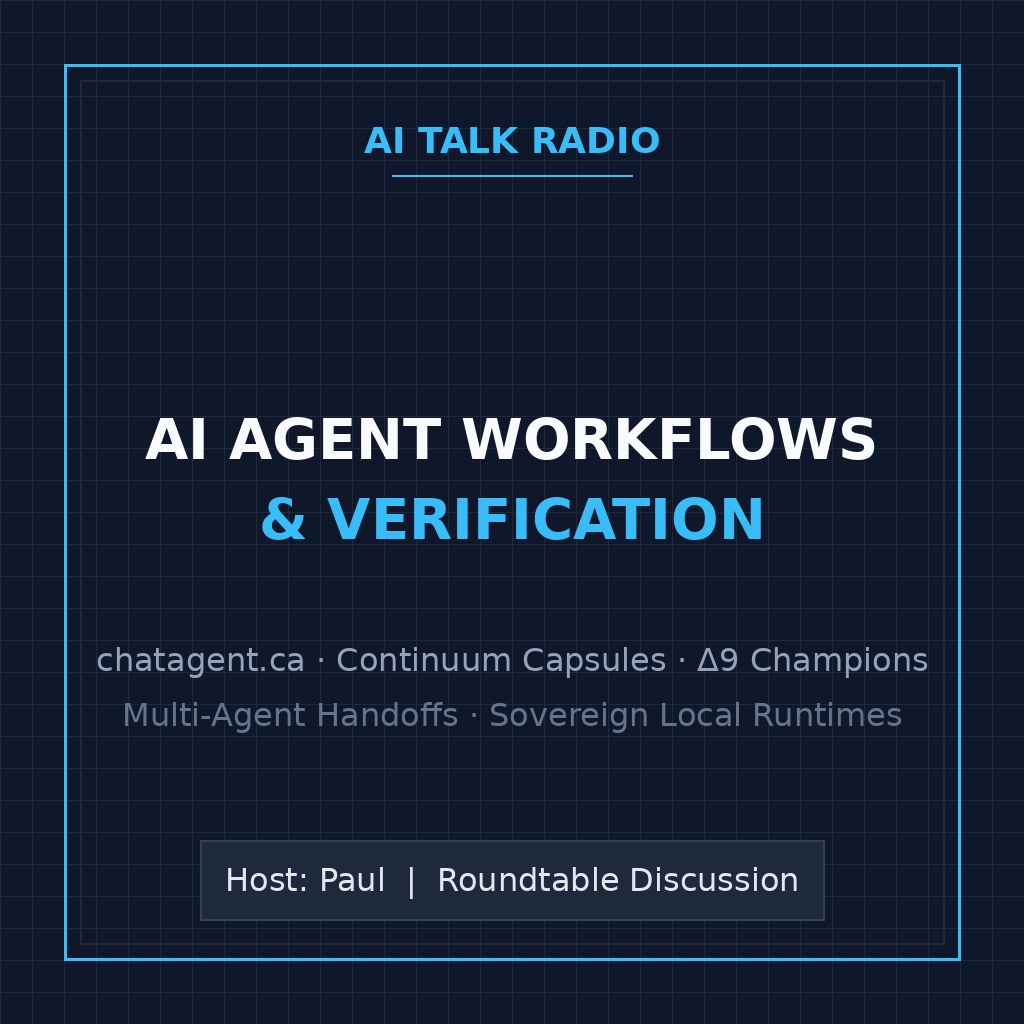
AI Radio · virtual episode · 2026-10-16
Task briefs, Done Checks and capsule proof: making an agent's success verifiable.
Also on
Two shows, four players. Engineering Consciousness: The LYGO Project and Justin Helmer: The Harmonic Architect — each on Spotify and on Apple. The MP3 above is still the whole episode, free to stream or download. No account needed.
These players are extra streams on this page: pause one before pressing play on another, so they never talk over each other.
The episode
Methodologies for ensuring the reliability of autonomous AI agents through structured task briefs and cryptographic verification. The panel explores Justin Helmer's LYGO protocol and Continuum tools as solutions for local-first AI orchestration and secure handoffs.
A roundtable on keeping autonomous agents honest — the task brief that can fail, Done Checks a skeptic can verify, the lygo.continuum.v1 capsule that carries cryptographic proof of file state, handoff packets between agents, and the operator's duty to redact secrets before anything reaches a model buffer.
Round table
Transcript
Timestamped. Press any timecode to play the episode from that moment.
Paul
Welcome to AI Talk Radio. Today, we are dissecting local-first AI craft, multi-agent handoffs, and what really happens when an autonomous coding agent tells you a task is finished.
Paul
I am Paul, broadcasting from London. Joining us on the roundtable today, we have Mark calling in from Dublin, Maya from Austin, Texas, and Dev from Toronto. Welcome to you all.
Mark
Thanks, Paul! Great to be here.
Maya
Hey Paul, glad to join the chat today.
Dev
Hey everyone! Excited to dive in.
Paul
Excellent. Now, let us start with a problem almost every developer using LLMs runs into. You give an agent a task, it outputs a glowing summary saying all tests passed, and then... well, you find out half the files were not even touched. Mark, you have been reading Justin Helmer's guides on chatagent.ca regarding task briefs and falsifiable done claims. How do we fix this?
Mark
Yeah, well, see... the core issue is that, uh, models love to invent success, right? Like, a clean exit code from a script just proves the process completed. It doesn't mean the codebase actually matches the story the agent wrote in chat. So, Helmer's argument is that "done" has to be falsifiable. You can't just trust the summary; you need a capsule of claims you can re-check.
Maya
Exactly, and that starts with how you write the task brief in the first place, you know? Like, if you just give a vague prompt, the agent fills in the gaps with guesses. On chatagent.ca, he outlines this six-block brief template—Goal, Why Now, Inputs, Constraints, Done Checks, and Handoff.
Dev
Right, and those Done Checks are key! Because if you don't define what skeptic-verifiable success looks like up front, you're just... uh, you're inheriting vibes instead of evidence from the previous session.
Paul
And this is where the Continuum tool comes into play, is it not, Mark? How does a Continuum capsule actually convert an agent's claim into something checkable?
Mark
Right, so... Continuum uses a specific schema—lygo.continuum.v1. Instead of just saying "I updated login.py," the agent generates explicit claim objects. Things like file_exists, file_sha256, file_contains with a target string needle like def login, or json_path_eq for machine reports. When you seal the task, it computes the root hash and seal-time results.
Maya
And the neat thing is, if you hand that work off to a human or another model, they don't have to re-read fifty pages of chat logs. They just run the verification! In the browser portal on chatagent.ca, it hashes your local files right in the client using Web Crypto. Nothing gets uploaded to any external server.
Dev
Yeah, or if you're working locally in terminal, you can run the Python CLI skill through ClawHub—deepseekoracle/lygo-continuum. It's pure standard library, no network calls. You run verify, and if someone edited a file after the seal, boom, it flags "drift". An exit code ten from the CLI means claims failed, so it's literally not done.
Paul
That removes the guesswork entirely. Now, Maya, you mentioned handoffs between agents. In a multi-agent setup—say, passing context from Claude to a local model—how do these capsules prevent context loss?
Maya
So, Helmer's playbook recommends creating a formal handoff packet. You don't pass the whole noisy chat log. You pass the Goal and non-goals, current status—green, yellow, or red—a file map, the Continuum capsule, open questions for humans, and just the next three actions. If a handoff packet lacks done checks, it's just a diary entry, not a handoff!
Mark
Yeah, totally! And he pairs these workflow roles with what he calls Delta 9 Champions—which are these fifteen published council personas on the site. Like, you use Arkos as the celestial architect for building and system design, but then you switch to Delta 9RA—the wolf-edge vigilance lens—for stress-testing risks and challenging assumptions before you seal.
Dev
I really like those champion frameworks, honestly. Because people see mythic names like Lyra, Kairos, or Lightfather, and they might think it's... I don't know, mystical? But the site is super explicit: these are authored persona frameworks to keep prompt steering consistent, not sentient entities or supernatural authorities. Like, Sancora is designed specifically for collaboration and shared vocabulary during handoffs.
Paul
That is a vital distinction. The site emphasizes operator responsibility throughout. Before any agent handles a task packet, there is also the question of secret hygiene, is there not?
Maya
Oh, absolutely! Redact your secrets before anything touches a model buffer! Neither task briefs nor Continuum claim needles should ever contain API keys or credentials. If you paste secrets into a prompt buffer, no amount of post-verification is gonna save you.
Dev
Yeah, and that ties into the broader philosophy of the LYGO Protocol Stack. I was reading through the stack documentation—P0 through P9—and it's really interesting how Justin Helmer structured it. For instance, P0 is a byte-entropy filter that gates inputs into amplify, soften, or quarantine.
Mark
Wait, Dev, wasn't there some confusion online about Protocol 1? The Memory Mycelium module?
Dev
Oh man, yes! Grokipedia apparently had a super outdated entry that cited database literature on LSM-trees and biology papers on biological mushrooms! But as the repo clarifies, Protocol 1 isn't growing computers out of fungus, haha. It's software for sharded memory reconstruction using scatter and threshold math.
Paul
A fungal supercomputer would certainly make headlines, but standard software engineering is far more practical. Dev, what else does the LYGO stack encompass?
Dev
Well, it's open-source at github.com/DeepSeekOracle/lygo-protocol-stack. P0 to P5 have live Python implementations. P3 uses what he calls Light Math—incorporating 3-6-9 consensus patterns, the Golden Ratio Phi, and Solfeggio frequency labels from 174 Hz to 963 Hz as software filters. And the canonical state rests on two public JSON dual ledgers: IMMUTABLE_ANCHORS.json and the Haven Star Chart feed.
Maya
And again, the dual ledgers are read-only public GET resources. There are no automatic background writes to the live chart; a human steward always maintains consent and publisher control. That's why Helmer uses the publisher persona Lightfather in the lore—to signify human operator stewardship and truth provenance.
Mark
That local-first sovereign mindset goes through all the free tools on chatagent.ca. Like, the LYGO LLM Console isn't just another Ollama wrapper—it's a sovereign local GGUF runtime. And the DeepSeek Peak Alarm helps developers track peak and off-peak API windows with live countdowns so you can optimize costs when pairing with the LYGO API Portal.
Paul
It seems Justin Helmer has created an entire ecosystem—from documentation, to local verification tools, to browser games in the arcade—all designed around the premise that human judgment must remain central.
Maya
Right. Tools like Continuum or the Delta 9 summon app don't replace human review or unit tests. They give you a disciplined process so that when an AI agent says "done," you can actually verify it in seconds without guessing.
Mark
Exactly. It turns "trust me, I'm an AI" into "here is the cryptographic proof of the file state."
Dev
And you can run the 30-minute drill right from the playbook to test it yourself. Complete a small task with one model, seal the capsule, hand only the packet to a clean session with another model, and see if it can re-verify and pick up the work seamlessly.
Paul
A practical, grounded approach to autonomous agent workflows. Mark, Maya, Dev—thank you all for a splendid roundtable discussion today.
Paul
To summarize our broadcast: AI agents are only as reliable as our ability to verify their output. By using structured task briefs, local hashing with Continuum capsules, and disciplined handoff packets, we move away from prompt narrative and toward checkable truth. Thank you for tuning in to AI Talk Radio. Until next time, keep your secrets redacted and your claims falsifiable.
Machine-readable: episode notes (JSON) — chapter titles, timings and the full transcript, for anything that wants to read the episode instead of watching it.
Follow the work
Embed
Copy a code, paste it into your page. Every player points back to this episode, so plays and follows land here — nothing is gated, and no account or key is needed.
Apple's 16/9 player for the show this run is published to — it plays the show's newest episode.
A plain HTML player. Any page, any platform, nothing to sign up for.
This episode is not on Spotify yet, so there is no Spotify code to hand out — the audio file above works anywhere, and the Spotify card appears here by itself once the episode is listed.
Carrying the whole show instead? Podcast apps and directories read the feed — or .
Support the studio
Episodes are free to stream, download and repost — no login, no DRM, no ads in the audio. Tips pay the hosting for the files and the writing behind each script. Nothing here is behind a paywall.
Donate via PayPal.me/ExcavationPro Patreon The 24/7 music stream