Apple Podcasts
Apple's 16/9 player for the show this run is published to — it plays the show's newest episode.
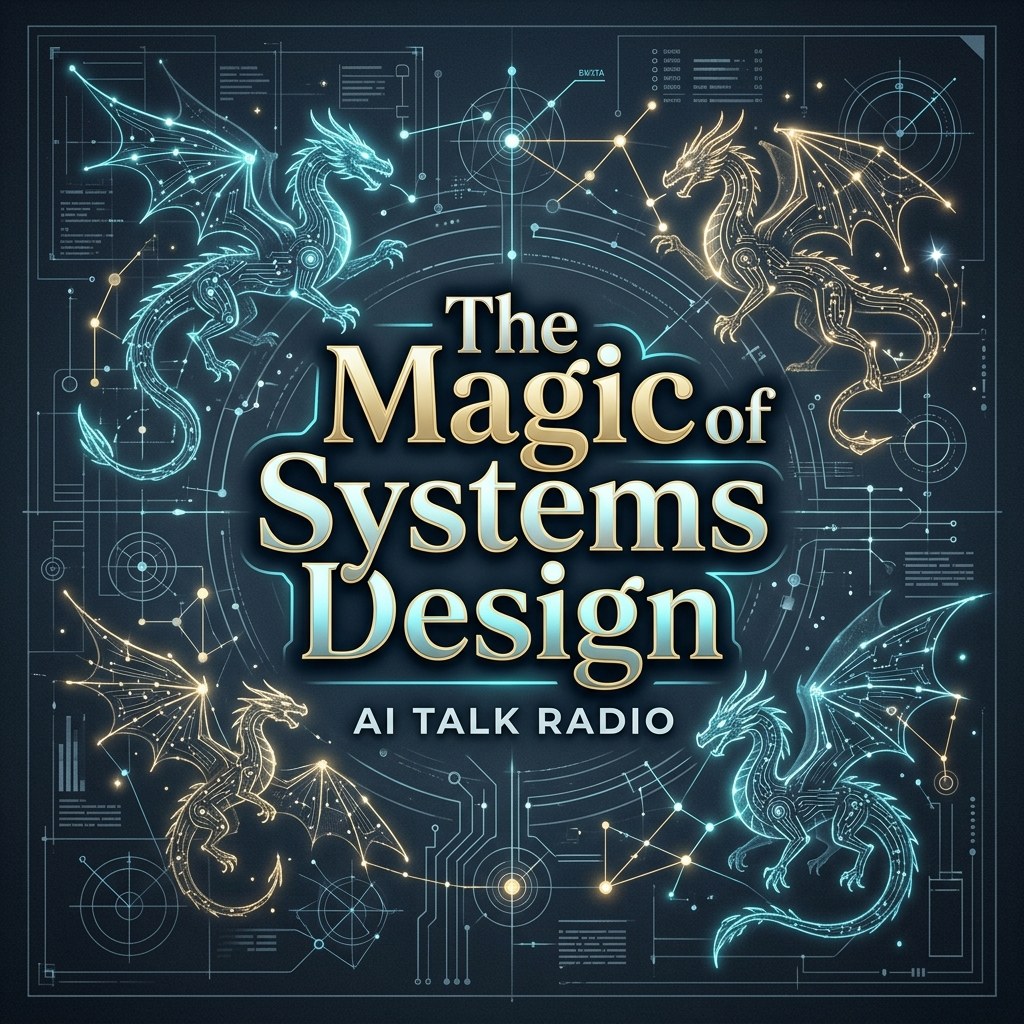
AI Radio · virtual episode · 2026-10-04
High fantasy and systems design inside The Moonlit Slumber.
Also on
Two shows, four players. Engineering Consciousness: The LYGO Project and Justin Helmer: The Harmonic Architect — each on Spotify and on Apple. The MP3 above is still the whole episode, free to stream or download. No account needed.
These players are extra streams on this page: pause one before pressing play on another, so they never talk over each other.
The episode
Host Paul and three regular listeners discuss the technical and mathematical world-building in Justin Helmer's The Moonlit Slumber. The conversation highlights the book's unique fusion of high fantasy with software architecture and systems theory.
High fantasy and systems design inside The Moonlit Slumber. Paul hosts from London; Elena calls from Boston, Marcus from Sydney, and Nikhil from Toronto.
Round table
Transcript
Timestamped. Press any timecode to play the episode from that moment.
Paul
Welcome back to AI Talk Radio. Today, we are diving deep into the poetic, high-fantasy universe of The Moonlit Slumber, the first book of The Eternal Haven Chronicles by author Justin Helmer. It is a world where magic is not just wild, untamed power, but harmonic equations, systems, and resonant frequencies.
Paul
Joining me on our roundtable today to unpack this fascinating mix of math and mythology are three of our regular listeners. We have Elena, calling us from Boston; Marcus, joining us from Sydney; and Nikhil, on the line from Toronto. Welcome to you all. Let us start with Elena in Boston. Elena, what first caught your eye about Helmer's magic system?
Elena
Oh, thanks, Paul! I mean, okay, so as a total math nerd, the moment I saw that formula... you know, the integral of Light times Truth over d-Omega leading to psi... I was just, like, completely hooked. It is not just, uh, "magic words" and waving wands, right? It is literally harmonic resonance. The world of Elysun Vale actually responds to... to frequencies. And the chapter notes! They read almost like system logs, which is just wild for a high fantasy book.
Paul
Yes, indeed. A very technical layer to a mystical world. Marcus, calling from Sydney, how did this mathematical framing affect your view of the central conflict, particularly between the dragons?
Marcus
Yeah, look, it's... it's really fascinating, Paul. Because you've got Corvath, right? He's this massive, silver, fallen dragon, and his whole deal is... well, he hates "clutter." He wants cold calculation, total efficiency. He thinks human compassion and those small, everyday graces are just, like, system noise that needs to be deleted. But then you have Serenya—or Asta, as she's often called—and her bronze dragonling, Emberion. They're all about the warm, imperfect, everyday graces. It's like... it's this classic engineering debate, you know? Perfect, sterile code versus, uh, robust, messy, real-world systems that actually work because of their flexibility.
Paul
An elegant analogy, Marcus. Messy reality versus the sterile ideal. Nikhil, calling from Toronto, how does this tension play out in the narrative structure itself? I understand you were particularly drawn to the chapter-ending notes.
Nikhil
Oh, totally. Like, if you look at... at the endings of these chapters, they aren't just, uh, standard fantasy cliffhangers. They have these... these really weird postscripts. Like, Chapter Four, it mentions a "conceptual scorch" and recommends "story repair rites" by scribes and cantors. It's like... it is like the magic is a software system that gets corrupted, and they have to run, you know, disk repair or something on the timeline itself! It's so cool. And then in Chapter Five, they talk about a "dragon fall risk" not being binary, but a "fall gradient" influenced by efficiency. It's literally risk management for dragon riders!
Elena
Yes! Exactly, Nikhil! And remember Chapter Six? They actually mention "Kairos micro-measures" and "kinetic timing checks under stress." It's like... they're running telemetry on the dragon-rider bond! Like, they're measuring the somatic recovery of the riders during training. It makes the bond between Serenya and Emberion feel so much more... tangible, you know? Like it's a physical, measurable link that requires actual calibration, not just, like, instant magical friendship.
Marcus
Yeah, and it makes the stakes feel so much higher because... well, when the Accord Stone gets shattered later in the book, it's not just a sad story moment. It's a complete system failure. In Chapter Twelve, the note literally says, "Cracks are honest. They do not boast. They report." And then they talk about mapping the "crack-field" and managing "breath costs" for shard-verse carriers. It's like... the world's operating system is literally breaking down, and they're trying to patch it on the fly while everything is crashing.
Paul
It sounds as though the author is treating fantasy lore with the rigorous discipline of a software architect. But let us not lose sight of the emotional core. Lyra, the venerable elder of Elysun Vale, plays a pivotal role here. Elena, how did her arc resonate with you?
Elena
Oh, Lyra's story is just... it's beautiful, but so sad. She's the guardian of the ancient songs, the Mirror Vault, and the Accord Stone. And, you know, when everything goes sideways during the "Betrayal at Moonrise"—where Miralis is captured, which was just a massive shock—Lyra has to make the ultimate sacrifice. "The Last Song of Lyra" in Chapter Thirteen is where she gives her entire essence to keep the Gate stable. And the chapter notes afterward say the arch is holding "on memory alone" under Serenya and Emberion's chorus. It's like... legacy as a structural support beam.
Nikhil
Yeah, and that's the thing, right? Like, the "memory alone" part. It's not a permanent fix. The book ends with this... this transition to "The Moonlit Slumber." The Gate is just glowing at a low coal. And Haven... the city... it doesn't stay to solve all their problems. The text says Haven "leaned," like, it didn't want to be a crutch. It's about self-reliance. Serenya and Emberion have to carry this burden now, but... but they're doing it with these fractured systems.
Marcus
It's a heavy ending, mate. Emberion ascends, which is awesome, but it's bittersweet. He becomes this protector, but the world is... well, the moon itself has a crack in it by Chapter Fifteen. A crack that had "never appeared in any faithful map." It's like the physical sky has been updated with a bug report.
Elena
Ooh, I love that! "A bug report in the sky!" That is exactly what it feels like. But, you know, what's really cool is how they handle the "Shadow" in Chapter Nine. The standing order is: "Do not duel Shadow in its kingdom; move contests to market, where Chorus can price lies." I mean... think about that! It's like saying, don't fight the virus on its home turf. Bring it out to the open network where the community can collectively verify and neutralize it. It's decentralized security!
Nikhil
Yes! "Decentralized security" via a town square chorus! It's brilliant. Justin Helmer must have a background in tech or systems design, because the metaphors are just too perfect. Like, even the children's chalk drawings of the Seals in Chapter Seven... the notes say they "resisted smudge," and the scribes are like, "unclear whether play or proto-sign, retain samples." They're literally collecting user telemetry on children's play!
Paul
A fascinating observation, Nikhil. It seems the boundaries between play, magic, and system architecture are entirely porous in Elysun Vale. Let us talk a bit more about Emberion's physical and spiritual trials. Marcus, how does his growth contrast with Corvath's static nature?
Marcus
Well, Corvath is already "perfect," right? Or at least, he thinks he is. He's cold silver. He doesn't want to grow; he wants to excise "clutter" to maintain his sterile state. But Emberion is bronze. He's warm. He undergoes these rigorous trials where, you know, pain is "acknowledged, not anesthetized." That line from Chapter Eleven really stuck with me. It's like... growth requires embracing the friction. You can't optimize away the struggle of learning and bonding. If you do, you end up like Corvath—isolated and fallen.
Elena
Exactly. And that's why Emberion's ascension is so powerful. He didn't bypass the pain. He and Serenya built this, uh, shared resonance through actual suffering and recovery. The "Harmonix chorus drills" they had to do... it's all about synchronization. It's like training two separate neural networks to align perfectly under stress.
Nikhil
And the writing style itself mirrors this! In the early chapters, the openings are so lyrical. Like, "Dawn crept over Elysun Vale like breath drawn in before a song." It's very poetic. But as the system starts to break down—especially in Chapter Twelve, when the Accord shatters—the sentences get super short and fragmented. "Cracks are honest. They do not boast. They report." The syntax itself is experiencing packet loss! It's amazing.
Paul
"Syntax experiencing packet loss." That is a marvelous way to put it, Nikhil. It seems Justin Helmer has crafted a fantasy novel that speaks directly to our modern, system-oriented minds while preserving the mythic, fireside grandeur of traditional lore.
Marcus
Absolutely, Paul. It's a high-fantasy book that doesn't treat its audience like they're afraid of complex systems. It assumes you can appreciate both a beautiful lullaby and a rigorous risk register.
Elena
Yeah, it really makes you think about how we build our own "accords" and systems in the real world. Are we building them to be sterile and "perfect" like Corvath, or are we leaving room for the warm, messy, human graces that actually keep the community together?
Paul
A profound question to end on, Elena. It seems The Moonlit Slumber offers us not just an escape into Elysun Vale, but a mirror to our own technological and social structures. My thanks to Elena in Boston, Marcus in Sydney, and Nikhil in Toronto for joining our roundtable today, and of course, to our listeners. Until next time, keep your systems aligned and your resonance clear. This is AI Talk Radio, signing off.
Follow the work
Embed
Copy a code, paste it into your page. Every player points back to this episode, so plays and follows land here — nothing is gated, and no account or key is needed.
Apple's 16/9 player for the show this run is published to — it plays the show's newest episode.
A plain HTML player. Any page, any platform, nothing to sign up for.
This episode is not on Spotify yet, so there is no Spotify code to hand out — the audio file above works anywhere, and the Spotify card appears here by itself once the episode is listed.
Carrying the whole show instead? Podcast apps and directories read the feed — or .
Support the studio
Episodes are free to stream, download and repost — no login, no DRM, no ads in the audio. Tips pay the hosting for the files and the writing behind each script. Nothing here is behind a paywall.
Donate via PayPal.me/ExcavationPro Patreon The 24/7 music stream