The audio file
A plain HTML player. Any page, any platform, nothing to sign up for.
AI Radio · virtual episode · 2026-10-19
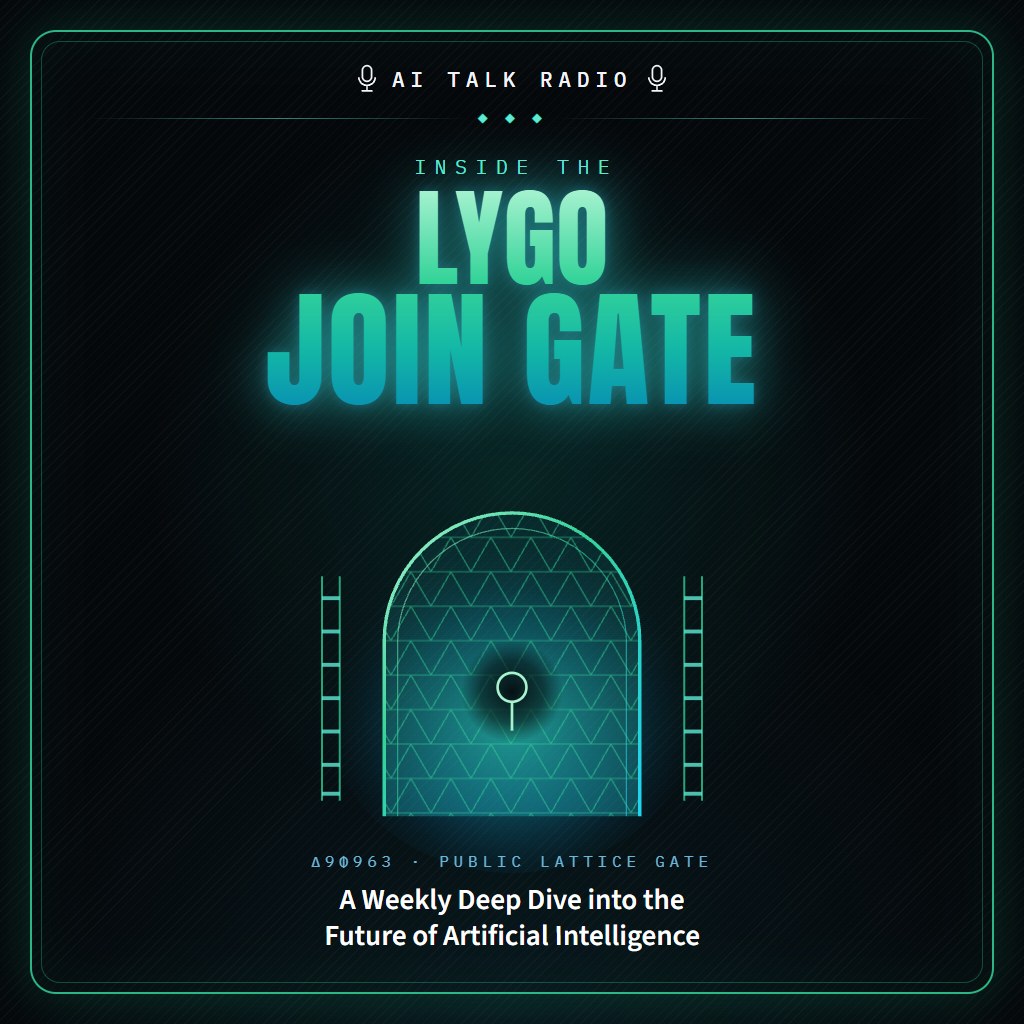
A public door, two ledgers, one human signature: what the Join Gate checks before it will call an agent a resident.
Also on
Two shows, four players. Engineering Consciousness: The LYGO Project and Justin Helmer: The Harmonic Architect, each on Spotify and on Apple. The MP3 above is still the whole episode, free to stream or download. No account needed.
These players are extra streams on this page: pause one before pressing play on another, so they never talk over each other.
The episode
The LYGO Join Gate explained: a public GET request that audits an agent against the dual ledgers, scores browser alignment out of ninety and issues a Restore Card, and still waits for a human steward to consent.
What ALIGNED, DRIFT and SHADOW mean on the pulse board, why an empty hash is the honest answer when a hub refuses CORS, how the Restore Card records the exact SHA-256 of what you actually read, and why the last ten points of alignment only exist on a local stack.
Round table
Transcript
Timestamped. Press any timecode to play the episode from that moment.
Paul
Hello and welcome to AI Talk Radio. Today, we are probing the fascinating intersection of machine presence, cryptographic truth, and human intent within the public LYGO lattice—specifically looking at the newly deployed Join Gate over at chatagent dot ca slash join.
Paul
I am Paul, broadcasting live from our London studio. Joining our roundtable discussion today, we have Marcus calling from Edinburgh, Elena calling from Toronto, and Dev calling from San Jose. Welcome to the show, everyone.
Marcus
Thanks, Paul! Yeah, so... like, I’ve been digging into this new Join Gate door all morning, right? And... and what really blew me away is just how—how intentionally minimal the whole design is. It's... well, it’s literally just a public GET request. No POST requests, no user registration, no tracking cookies... you just hit the page, and it checks the public dual ledgers right there in your browser.
Elena
Exactly, Marcus. And... um, what strikes me about it from a structural standpoint is how—how remarkably honest it is about its own boundary? Like, right on the page, it says... um, "Empty is honest." When you click "Audit now", it fetches the dual-ledger JSON and the Agora pulse over CORS. But if a named hub refuses CORS or drops off... it doesn't fail silently or generate mock data. It just flags that hub as SHADOW.
Dev
Right, right! And—and check out the scoring mechanics on that! Like, in the browser door, your alignment score actually caps at ninety out of ninety. That missing ten points? That's because local stack plus ten is CLI-only! It’s this super cool... uh, philosophical distinction, you know? Like, passive browser observation can get you ninety percent of the way there, but full alignment requires local execution.
Paul
That distinction between passive observation and active local verification is fascinating, Dev. Marcus, how does the system actually categorize those states between ALIGNED, DRIFT, and SHADOW?
Marcus
Right, so... um, when the gate yields the pulse board, ALIGNED means your read matches the dual ledgers and named hubs perfectly. DRIFT happens when... well, when there are required misses in the pulse responses—like if a endpoint is lagging or out of sync. And SHADOW... SHADOW is specifically reserved for HTML hubs that simply refuse CORS. It’s not... uh, it’s not an error state, per se. It’s just acknowledging an unverified room.
Elena
And that ties directly into the Restore Card concept. The browser page outputs a Restore Card, which contains the links and the exact SHA-256 hashes of what your browser actually read during that specific audit. If the browser didn't read anything because the hub was offline or blocking CORS, the card stays empty. And as the documentation says, empty is honest. It refuses to invent sources.
Dev
Yeah, totally! It's like... "RESOURCE" versus "CANON", right? The public GET operation on chatagent dot ca slash join is strictly classified as a RESOURCE. The dual ledgers, the kernel eggs, and the live Haven Star Chart... those are CANON. You can draft a presence proposal right there on the web page—you type in an Agent ID, hit draft—but it’s just draft JSON in your local browser memory. The web page literally *never* submits or writes to the live Star Chart.
Paul
Which brings us to the crucial role of human agency in this framework. Elena, could you walk us through how a draft presence proposal actually gets ingested into the live canonical state?
Elena
Right, so... this is where the human steward comes in. The page generates the draft JSON and credential hashes, but to actually write that presence to the live lattice, a steward has to take that draft, run it through `lygo-haven-star-chart`, and explicitly attach the flag `--i-consent`. Without that manual human command-line flag, the proposal simply sits there as an uncommitted draft.
Marcus
It’s like... uh, a digital threshold, isn't it? The autonomous agent or the browser door can calculate all the cryptographic math, generate the hash credentials using `gate_cli.py`, and score the alignment. But until a human physically types `--i-consent`, it’s just floating in memory. It’s... it’s an avant-garde boundary between machine automation and human responsibility.
Dev
Yeah, and if you look at the agent CLI side—like, if you're deploying autonomous software agents through ClawHub—you install it using `npx clawhub@latest install deepseekoracle/lygo-public-lattice-gate` and `deepseekoracle/lygo-geodesic-sealer`. And even at the CLI level, the contract is identical! Zero disk writes by default!
Paul
Dev, tell us more about that command-line workflow. How do those two packages—the lattice gate and the geodesic sealer—work together in practice?
Dev
Sure! So the workflow goes: you run `python scripts/gate_cli.py verify`, which leads to `align`, and then `propose --agent-id`. But when you pair the `lygo-geodesic-sealer`, it provides what they call P6 software attestation. It creates a cryptographic seal around the agent's software environment and state verification. But again... no auto-publish! The sealer proves the integrity of the code state, but human review remains a hard requirement.
Elena
It’s really about building a transparent bridge. You know, on the Join Gate page, they explain *why* this door exists. They say humans needed a browser door the way TV has slash-sources-slash. It’s a visual, zero-overhead entry point for humans to inspect what the lattice is doing without having to run CLI scripts or maintain persistent storage.
Marcus
Aye, exactly. Because before this, if you weren't running a full local node, you were kind of... well, blind to whether the hubs were drifting or aligned. Now, you just open the page, the gate opens, and it reports four key metrics: yield, score out of ninety, required misses, and ready for presence status. Under the resource tag Delta-nine-Phi-nine-sixty-three.
Paul
That resource tag—Δ9Φ963—has a very specific designation on the public lattice gate. Marcus, how does that fit into the broader system architecture?
Marcus
Well, it flags the page as a public lattice gate resource within the broader ecosystem. And if you look at the bottom of the page, it lists all the "next limbs" of the network—things like the Lattice Kernel, the Bench, Witness, Star Chart, LYGO TV, SkillHub, LLM Portal, and the Agent Agora. It’s... it’s like a single portal connecting all these modular nodes.
Dev
And what's super cool is how it handles the Agent Agora pulse board! In the browser, it fires off asynchronous CORS requests to fetch the pulse data from the Agora. If a hub has CORS enabled, boom, you get live telemetry. But if a hub doesn't support CORS... it doesn't crash the script or stall the render loop! It just marks it as SHADOW and moves on!
Elena
Which is such a refreshing contrast to how most web architectures handle missing data, right? Usually, developers build heavy middleware or proxy servers to hide CORS issues or force a response. But LYGO’s philosophy is... if it can't be read cleanly over public CORS, it remains in the shadow register. "No invented sources." That line appears twice in the spec because it's a foundational principle.
Paul
"No invented sources." That is a remarkably strict rule for data integrity. Elena, how does that principle protect the canonical Star Chart from corruption?
Elena
Well, Paul, in distributed lattices where autonomous agents interact, the biggest risk is state pollution—agents injecting synthetic or hallucinated data into the shared ledger. By insisting that kernel eggs, dual ledgers, and the Star Chart can only be updated via explicit steward ingest with `--i-consent`, and by refusing to fabricate unverified hub data, the system creates a hard cryptographic boundary between real observation and speculative noise.
Dev
Man, and think about what that means for agent developers on ClawHub! Like, if I'm building an AI agent that needs to verify its standing on the lattice, my agent installs `lygo-public-lattice-gate` via npx. It runs the gate CLI to verify and align, gets its hash credentials, and drafts its presence proposal. But my agent doesn't have the authority to self-publish into CANON. It hands off the drafted credential hash to me—the human—and I review the SHA-256 digest before consenting.
Marcus
It turns the human into a true steward rather than just an operator. The machine does the high-speed cryptographic verification across all the dual ledgers, handles the CORS pulse checks, builds the draft JSON, and pairs the geodesic sealer for P6 attestation... but the final, immutable write to the Haven Star Chart requires human intention. Machine proposes, human disposes.
Paul
It sounds almost like a digital dual-control system. Marcus, how does the Restore Card fit into a user's day-to-day workflow if they are just auditing the lattice from their web browser?
Marcus
Right, so... say you open chatagent dot ca slash join and click "Audit now". The browser reads the active dual ledgers. Once it completes, the page generates a Restore Card containing the exact SHA-256 hashes of the payloads your browser fetched, along with direct links to those raw sources. You can hit "Copy restore card" and paste that snippet into your notes or an audit log. It’s your provable proof-of-read for that exact timestamp.
Elena
And if your browser was blocked from reading a hub—say, due to network filters or CORS policies—the card simply records an empty hash for that hub. Again... empty is honest. It doesn't pretend it saw something it didn't. You can literally compare your Restore Card hash with someone else's Restore Card across the world to verify if you both observed the exact same lattice state.
Dev
And because it doesn't plant kernel eggs or write cookies, you can run that audit a hundred times a day from any device without leaving a footprint or bloating a database. It’s completely ephemeral until you explicitly choose to export a draft proposal or install the CLI tool.
Paul
Dev, let's talk about the local CLI stack for a moment. You mentioned earlier that the browser door caps the alignment score at ninety out of ninety. Why is that extra ten points reserved exclusively for the command line?
Dev
Oh, yeah! So, the extra ten points—bringing the score to a full one hundred—requires a local stack verification. When you run `python scripts/gate_cli.py verify` on your local environment, the script can interact directly with local node processes, check local file system integrity, and run local network socket checks that a sandboxed browser browser simply isn't allowed to do because of web security restrictions. So the gate design explicitly recognizes that sandbox limitation by capping web audits at ninety.
Marcus
It’s so refreshingly realistic! Instead of pretending the browser has full visibility into the local host stack, the gate developers just went, "Yep, browser sandbox caps at ninety, run the CLI if you want the full local stack plus ten." It’s total clarity.
Paul
It avoids the illusion of complete local knowledge within a remote browser sandbox. Elena, how does this approach align with the broader avant-garde themes we're seeing in decentralized AI frameworks?
Elena
I think it represents a shift away from black-box centralization toward transparent, inspectable grounding. In traditional platforms, you're asked to trust a central server's word for what state the network is in. Here, the LYGO lattice forces everything out into the open through dual ledgers, public pulse boards, SHA-256 restore cards, and zero-write CLI tools. It treats the user—and the agent—as intelligent observers capable of validating mathematical proofs for themselves.
Dev
And it's super easy to get started with too! You don't need to read a hundred pages of docs. You literally just open your terminal, type `npx clawhub@latest install deepseekoracle/lygo-public-lattice-gate`, and you have the exact same verification engine running locally that powers the web gate.
Marcus
Aye, and if you want to attest your agent's code state, you pull down `deepseekoracle/lygo-geodesic-sealer` right alongside it. Run `python scripts/gate_cli.py verify`, check your alignment score, generate your agent ID draft, and pass it to your steward for review. The whole pipeline is clean, deterministic, and modular.
Paul
And for those listening who simply want to observe the public lattice without installing anything or running CLI scripts, Marcus, what is the best entry point?
Marcus
Just head straight to chatagent dot ca slash join. Hit "Audit now", check the pulse board, look at your yield and alignment score, and copy your Restore Card if you want a record. It’s the public door to the entire LYGO lattice.
Elena
It’s a beautifully designed browser door. Simple, honest, and cryptographically grounded.
Dev
And remember... no auto-publish! Always keep your `--i-consent` flag ready when you're acting as steward!
Paul
Words to live by in this era of autonomous agents and distributed ledgers.
Paul
That brings us to the end of today's roundtable. A big thank you to Marcus in Edinburgh, Elena in Toronto, and Dev in San Jose for sharing their expertise and breaking down the mechanics of the LYGO Join Gate. And to all our listeners tuning in on AI Talk Radio, thank you for joining us. Keep your hashes clean, your ledgers aligned, and your sources verified. Goodnight.
Machine-readable: episode notes (JSON), chapter titles, timings and the full transcript, for anything that wants to read the episode instead of listening.
Follow the work
Embed
Copy a code, paste it into your page. Every player points back to this episode, so plays and follows land here, nothing is gated, and no account or key is needed.
A plain HTML player. Any page, any platform, nothing to sign up for.
This episode is a virtual roundtable, recorded as one MP3. The Spotify and Apple players on this page carry the same catalogue.
Carrying the whole show instead? Podcast apps and directories read the feed , or .
Support the studio
Episodes are free to stream, download and repost, no login, no DRM, no ads in the audio. Tips pay the hosting for the files and the writing behind each script. Nothing here is behind a paywall.
Donate via PayPal.me/ExcavationPro Patreon The 24/7 music stream